


BY: Davey Chadwick (WMSB Co-Founder)
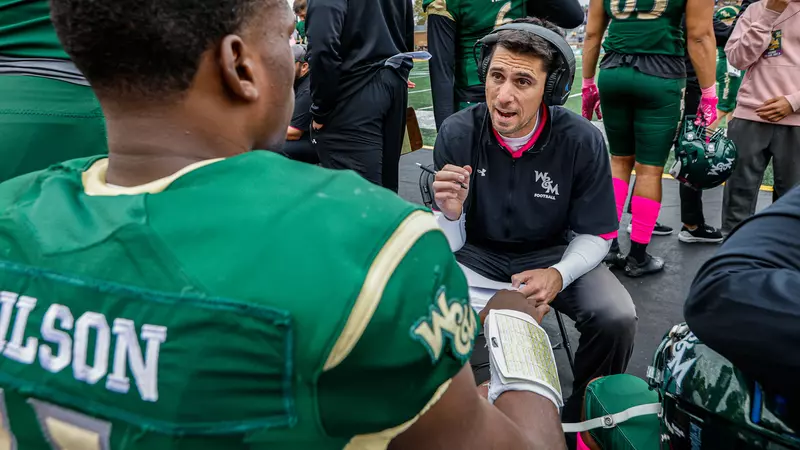
Few careers in football have been as well-traveled and well-earned as Christian Taylor’s. A former William & Mary quarterback turned coach, Taylor has carved out an impressive path in the coaching world, from his early years at his alma mater to leading record-breaking offenses at San Diego, and now to his current role with the Buffalo Bills.
In this exclusive William & Mary Sports Blog interview, Taylor reflects on his journey from player to coach, the challenges of building winning cultures, and the lessons learned from coaching at every level of the game. From breaking Jim Harbaugh’s records at San Diego to navigating COVID-era football at William & Mary and adapting to the NFL, Taylor’s story is one of adaptability, leadership, and a deep passion for the game.
Now, as he continues to grow within one of the NFL’s most respected organizations, Taylor offers insight into what makes great teams, great players, and great leaders.
WMSB: Coach, really appreciate you taking the time here after the season. This is really special for me because you represent two of the things I hold very dear to my heart— William & Mary and the Buffalo Bills. Also, I really appreciate you taking the time back in Week 1 to bring me, my brother, and our dad, a lifelong Bills fan from Buffalo, around the Bills facility. That meant a lot.
To jump right in — starting chronologically from your own playing and coaching career — what initially drew you to William & Mary? I imagine growing up in Yorktown played a big role, but I’m curious to hear your path and how you ended up at W&M as a player.
Christian Taylor: I was looking for a school that had the best combination of athletics and academics that I could find and attend. It came down to the University of Virginia and William & Mary, and W&M just felt like the better fit at the time. Like everyone, I wanted to challenge myself as a student-athlete — get the best degree possible and play football at the highest level I could.
WMSB: Were you always planning to stay in-state? You mentioned a couple of big Virginia schools, but did you ever consider going elsewhere?
Christian Taylor: Yeah, I was open to going anywhere. I was attracted to in-state schools, obviously, because of the proximity to home and being closer to family. But I wasn’t locked into staying in Virginia — it just happened to work out that way.
WMSB: What were some of the biggest influences on you as a player at W&M that later shaped your coaching career? Any favorite memories from your playing days?
Christian Taylor: That’s a tough one because there were so many influences. Honestly, I think what I appreciate most now is how everyone at William & Mary — students, athletes, professors — are just the elite of elite among 18- to 23-year-olds in the country. They’re some of the smartest, most motivated, and determined people you’ll ever meet. And being surrounded by those kinds of people every day pushes you to reach your potential, whether that’s on the field or in the classroom.
As far as memories, it’s got to be the bond with teammates. You go through struggles together, and anytime you struggle with someone, it builds a natural bond. Luckily, we had a lot of success while I was there. One memory that stands out was the 2004 semifinal game against JMU — seeing people camp out outside Kaplan Arena starting Sunday night because tickets went on sale Monday morning.
ESPN wanted the Friday night game, so they had to bring in portable lights since we didn’t have permanent ones. It was a sellout, and the stadium was already packed during warmups. That game just reinforced how much W&M football means to the community.
WMSB: You played under Coach Laycock, a legendary figure at W&M. How did playing in his system shape your understanding of the game?
Christian Taylor: He was one of the best offensive minds in football for a long time. Seeing how that was organized, the groundwork, the teaching progression of an offense — I learned so much. First as a player, then as a coach under him. One of the biggest things I took from him was the value of accountability. Holding each other accountable daily is simple in theory but hard to execute. He wasn’t afraid to tell people what needed to be done better, and I really valued that.

WMSB: After playing, you ended up coaching. Did you always know you wanted to go into coaching, or did you consider other career paths?
Christian Taylor: I actually wasn’t sure at first. I knew I wanted to either coach or go into physical therapy. Right after graduating, I started physical therapy grad school at Old Dominion. I did a summer semester there, but when football season rolled around, I realized how much I missed it. That was my first year since I was six years old not playing football, and it just felt wrong. That’s when I knew I had to get back into it. I called up Coach Laycock and told him I needed to coach, and he brought me on board right away.
WMSB: So, starting at William & Mary, Coach Laycock put you as the tight ends coach right out of the gate. What was that experience like, and how did it shape you early in your coaching career?
Christian Taylor: Yeah, so Coach Laycock put me with the tight ends right away, which was an awesome opportunity. As a former quarterback, I already had a strong understanding of the passing game, but working with tight ends forced me to get fully immersed in the run game too. That was a huge learning experience because, as a tight ends coach, you’ve got to be able to communicate and coach both aspects of the offense, running and passing.
I worked really closely with Bob Solderitch, the longtime offensive line coach at W&M. God rest his soul — I loved him to death. I learned so much from him, particularly about offensive line play. As a tight ends coach, your language and teaching points have to match what the O-line is learning. If you’re coaching tight ends and saying something different from what the O-line coach is saying, it’s a problem. So, it really opened my eyes to coaching at a detailed level.
I also coached the kickers and punters, which was another unique challenge. I had never really been involved in special teams coaching before, but it was a great way to expand my knowledge of the game. That first year, I was just trying to be a sponge and learn as much as possible.
WMSB: And then in year two, you transitioned over to coaching quarterbacks, right?
Christian Taylor: Yeah, my second year, Coach Laycock moved me over to the quarterbacks, which, obviously, was a position I was really comfortable with. But coaching it is completely different than playing it.
That season, I had the chance to coach RJ Archer, and we ended up making it to the national semifinals in 2009. That was an incredible experience. RJ was a former wide receiver who transitioned back to quarterback, so his development was a huge focus for us. He was an incredibly smart player and a great athlete, and we built a really strong offense around him.
That year also gave me my first exposure to game-planning at a high level, helping build an offense week-to-week, and adjusting based on our personnel and the defenses we faced. We had a great run that season, and it really solidified for me that coaching was what I wanted to do long-term.

WMSB: I know your wife is from San Diego. Following your experience at W&M, was she part of your journey when you ended up coaching in California?
Christian Taylor: Yeah, she’s from San Diego, and that played a role in my decision-making. We did long-distance for some time, which was tough. After two seasons coaching at William & Mary, I ended up at San Diego State working under Al Borges and Brady Hoke as an offensive analyst. We had a great season, won the Poinsettia Bowl, and were close to going undefeated. Then Coach Hoke got the Michigan job and asked if I wanted to come with him. I jumped at that opportunity.
WMSB: What was it like working at Michigan?
Christian Taylor: Amazing. Michigan is one of the best college football programs in history. I got to work with Denard Robinson, won the Sugar Bowl against Virginia Tech, and just learned so much. I also realized how much I love being in environments where the community is all about their sports teams.
WMSB: So after Michigan, what was the next step in your coaching journey before eventually coming back to William & Mary?
Christian Taylor: My path has been very interesting, Davey. There is no set path in this profession. I wish there were — my brain operates in a way where I like things to be linear. Like, “If you do this well, then this is next.” But that’s just not how it works in coaching.
I had an opportunity at the University of San Diego to be a position coach and recruiting coordinator. It was a really tough decision to leave Michigan — I went back and forth on it for a while. But the chance to coach my own position again at a really good FCS program and be back closer to my wife and kids, who had stayed in San Diego, made it the right decision at the time.
WMSB: That makes a lot of sense. How long were you there, and what was that experience like?
Christian Taylor: I was there for two years, and we had great success. We won the conference both years, and I got to coach a new position — running backs — which I hadn’t done before. That was a big learning experience for me. I also took on the role of recruiting coordinator, which was huge. I got exposure to the administrative side of things — working with admissions, financial aid, compliance, and setting up recruiting visits. That gave me a much broader perspective on how a program operates outside of just X’s and O’s.
WMSB: Right, and I feel like in today’s era of college football, recruiting is as important as anything. And then from there, you went to Illinois Wesleyan, right?
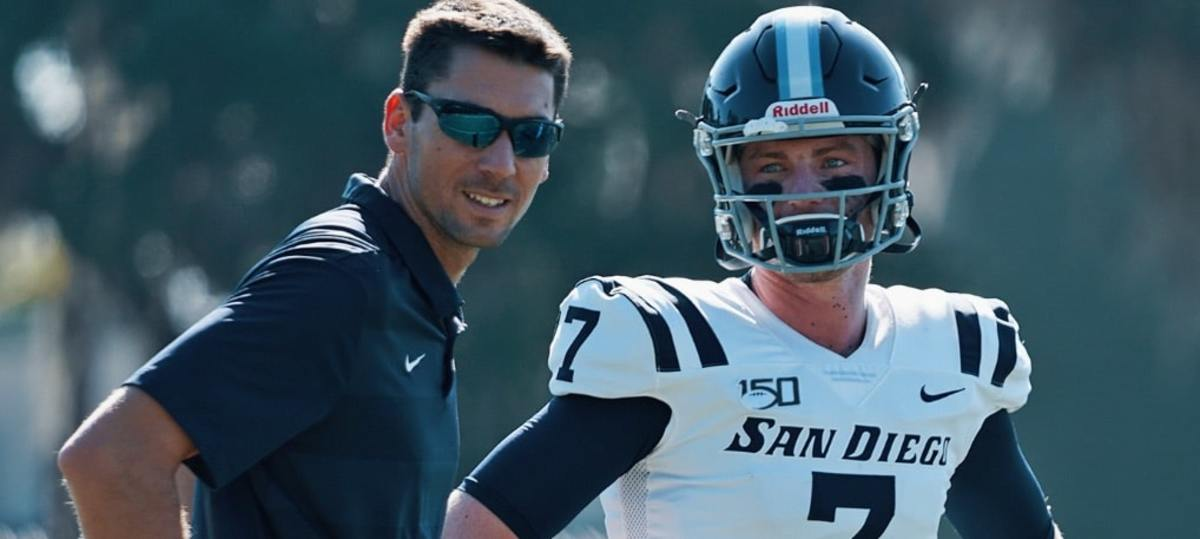
Christian Taylor: Yeah, after San Diego, I took an opportunity at Illinois Wesleyan, which is a really strong Division III program. That was my first offensive coordinator job, and I wanted to get that experience. There’s just no substitute for actually doing it. We had a lot of success there over two years. Then, I went back to San Diego as the pass game coordinator and ended up staying there for four years. I worked my way into the offensive coordinator role and we had an incredible run.
WMSB: Yeah, I remember reading about that — San Diego really took off. You guys broke a bunch of records, right?
Christian Taylor: We did. We ended up setting the national record for consecutive conference victories — 39 straight wins in conference play. That was the third-longest streak in the history of college football. We broke a bunch of Coach Jim Harbaugh’s records at San Diego, had four Payton Award finalists, and really built something special there. It was a great time — good players, great staff, and living in one of the best cities in the country.
WMSB: That’s incredible. And then after all of that success, William & Mary came calling in 2020?
Christian Taylor: Right. The call from Coach London came at a time when the program was really trying to rebuild after some tough seasons. There was a clear vision for getting William & Mary football back to where it belonged, and I wanted to be a part of that process.
But, of course, what no one saw coming was COVID hitting right in the middle of my transition.
WMSB: Yeah, so you took the job right as COVID started shutting everything down, right?
Christian Taylor: Exactly. Following spring ball, I officially moved across the country while COVID was hitting. I was in the middle of a cross-country drive, going from San Diego to Williamsburg, and every day, the news got worse. Everything was shutting down — stores, restaurants, airports. No one knew what was going on.
And from a football perspective, it was a total curveball.
WMSB: That had to be a nightmare as a first-year coordinator. How do you install a new offense over Zoom?
Christian Taylor: It was definitely a challenge. That fall in 2020, we could do work outside, including walkthrough and limited practice with players. But we couldn’t do any meetings inside together for over a year.
I was also the only new coach on the offensive staff, which was unique in itself. Usually, when a new OC comes in, you might bring in assistant coaches you’re familiar with, but in this case, I was stepping into an existing staff. Luckily, it was a great group of guys, and we all worked really well together.
But the biggest challenge was trying to build relationships with the players without spending as much time with them in person.
WMSB: I can’t even imagine. Did you feel like you had to change how you coached because of it?
Christian Taylor: 100%. The whole approach had to shift. Normally, when you install an offense, it’s a progression-based learning system — you start with foundational concepts, then layer in details. But with everything online, we had to over-communicate every single detail and make sure guys were truly understanding it.
One thing we really leaned into was film study. If we couldn’t be on the field, we were going to master the mental side of the game. We spent hours breaking down tape, studying defenses, and making sure guys had total clarity on their assignments.
WMSB: And then you finally get a season… kind of. You had that weird three-game spring season in 2021. What was that like?
Christian Taylor: Yeah, it was the strangest season I’ve ever been a part of. We basically had an entire year without games, and then suddenly, we get thrown into a three-game season in the spring of 2021. It was unlike anything I’d ever experienced.
From a coaching perspective, it was tough because you’re trying to develop players, but it’s such a disjointed process. You go from no football for a year to three games, then you have to reset for a full fall season later that same year.
But, in hindsight, those three games were crucial. That’s when we started to see the identity of the offense take shape. That’s when we first experimented with the two-quarterback system, and it really started working.
WMSB: Right — this is where we started to see Hollis Mathis and Darius Wilson both take snaps, and the offense really started evolving.
Christian Taylor: Yeah, Hollis Mathis was our starter that spring, and he was playing really well before he got hurt. But then Darius Wilson came in, and we saw that we had two really talented, mobile quarterbacks.
That was a huge moment because we realized, we don’t have to pick just one. We can find ways to get both of them on the field at the same time, and that’s what led to the two-quarterback system that ended up becoming one of the most creative in the country.
It wasn’t something we planned from the start — it was just adaptation to what we had. And that goes back to what I believe about being adaptable; the best coaches don’t force players into a rigid system. You build the system around your players.
WMSB: And by 2022, that system was one of the most innovative in the FCS.
Christian Taylor: Yeah, 2022 was the year everything clicked. It wasn’t just the two-QB system — it was the entire offensive identity we had been building since 2020 finally coming together.
That season, we had an elite rushing attack, a dynamic passing game, and an offensive system that kept defenses guessing every week. I think that was one of the things that made us so dangerous — we had a different way to attack teams every single game.
WMSB: And you guys made serious national waves, especially in that UNC-Charlotte game [where W&M beat an FBS team on the road], right?
Christian Taylor: Yeah, that game was a turning point.
Our coaching staff put together a great game plan and our players executed it flawlessly. The team had a lot of fun executing some of our offense’s new, creative wrinkles that we were just beginning to utilize, and they played with incredible enthusiasm and effort; the team was determined to make history that night.
WMSB: That was when you started getting some serious national recognition as one of the most creative offensive minds in the FCS.
Christian Taylor: Yeah, it was pretty cool to see people take notice, but honestly, it was about the players executing. I’ve always said, “Good coaching is about putting guys in positions to succeed, then letting them play fast.” And that’s what happened.
WMSB: And that success led to one of the best seasons in program history, right?
Christian Taylor: Yeah, 2022 was historic for us as a team. We won the CAA, made a deep playoff run — it was everything we had worked for since that bizarre COVID year.
What made it special was how selfless the guys were. There were no egos, no drama — everyone bought into the system and their roles. That’s rare at any level, but when you get a group like that, you can accomplish something special.
WMSB: So after an incredible 2022 season at William & Mary, you get a call from Coach Sean McDermott and the Buffalo Bills. How did that opportunity come about?
Christian Taylor: William & Mary was the initial connection — again, going back to how special the place is and the type of people that come out of there.
Coach McDermott was getting inducted into the William & Mary Hall of Fame in Williamsburg after one of our spring games following the 2022 season. I had not met Coach McDermott yet, but we knew of each other.
He wanted to talk some football and see what we were doing offensively with all the success we were having. So we sat down, talked ball, had a great chat, and kept in touch.
Then, after the Bills’ season, he called me up and offered me the opportunity as a Defensive Assistant coach.
WMSB: What was it like making that move?
Christian Taylor: When Coach McDermott, who’s leading one of the best professional organizations in all of sports, offers you a job, you say yes.
But I didn’t know what to expect moving to the defensive side of the ball. It was completely new to me. I had always coached offense — quarterbacks, tight ends, play design, all of that.
Suddenly, I’m sitting in defensive meetings, breaking down how offenses try to attack defenses instead of designing the attack myself.
At first, it was a huge adjustment, but I learned a ton — probably more this year than I have since my first year coaching.
WMSB: What was your role this past season season, your first with the Bills?
Christian Taylor: My main responsibility was to be an expert on the opponent’s offense each week. That meant:
- Breaking down film of opposing teams.
- Identifying tendencies, formations, and play-calling patterns.
- Helping our defense prepare for what they were going to face.
- Running scout team looks to give our players the best preparation possible.
- Tracking what the offense was doing in real time during games — were they sticking to their tendencies or making adjustments?
I also realized that having an offensive background was a huge advantage on a defensive staff. I could sit in the meetings and offer the offensive perspective — what I’d be thinking as a play-caller, what I’d attack.
That insight helped the defensive staff make adjustments.
WMSB: What were your biggest takeaways from your first NFL season?
Christian Taylor: The biggest thing was seeing how belief and trust in each other can carry a team.
There was a lot of outside noise this year, but inside the building, the culture never wavered. It was a special group of guys who just kept working.
WMSB: Any favorite moments that stand out?
Christian Taylor: Winning my first NFL playoff game was a special one.
Also, going undefeated at home — Bills Mafia is real. The home-field advantage here is incredible, and you don’t go 10-0 at home without them.
It was just a great experience every day — being surrounded by great people, great players, great coaches who all worked toward the same goal.
WMSB: Now that you’ve got a full year under your belt, how do you see this experience shaping your career?
Christian Taylor: It’s made me a more complete coach — understanding the game from both sides of the ball.
I’ve learned so much from the people here — Coach McDermott, the defensive staff, the players. I’m grateful to be part of an elite organization.
WMSB: I want to end with this question: how did William & Mary prepare you for where you are today?
Christian Taylor: It gave me confidence. When you see so many W&M grads succeed in different fields, you realize you can be the best in the world at whatever you choose to do. The environment challenges you to grow in every way possible.
WMSB: Coach, I just want to close on this note — beyond the X’s and O’s, I think what stands out most in hearing you speak is how much you genuinely care about your players, your teams, and the cultures you help build.
Hearing you talk about how hard it was for you personally to leave William & Mary, San Diego, and every stop along the way speaks volumes. It’s clear that you don’t just coach football — you build deep, lasting relationships with the people around you.
That kind of leadership — true, empathetic leadership — is something I greatly admire, and it’s why I know you’ll have continued success in this profession.
Christian Taylor: I appreciate that, Davey. To me, coaching has always been about the people. Wins and losses come and go, but the relationships last forever.
WMSB: Absolutely agree. Well, we’re all excited to see where your career takes you next, Coach — whether in Buffalo or wherever the journey leads. Thanks again for taking the time to chat!
Christian Taylor: Always happy to, Davey. Anything I can do for Tribe Nation, I’m here to help.
Go Tribe and Go Bills!
 The William & Mary Sports Blog